




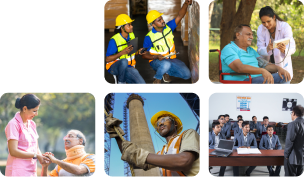
Deen Dayal Upadhyaya Grameen Kaushalya Yojana (DDU-GKY) is a placement-linked skill development initiative under the Ministry of Rural Development (MoRD), Government of India, designed for rural youth aged 18–35 years. Launched on 25 September 2014, the program focuses on empowering young individuals from rural poor households by equipping them with industry-relevant skills, professional certification, and access to employment opportunities.
The scheme aims to transform rural youth into a skilled, confident, and economically independent workforce by ensuring quality training and sustainable job placements with regular monthly salaries. Through structured training programs and strong industry partnerships, DDU-GKY promotes long-term career growth and improved livelihoods for rural communities across the country.
For more information, please visit DDU-GKY
The Pradhan Mantri Kaushal Vikas Yojana (PMKVY) is the flagship skill development scheme of the Ministry of Skill Development and Entrepreneurship (MSDE), implemented by the National Skill Development Corporation (NSDC). Launched in 2015, PMKVY aims to enable Indian youth to acquire industry-relevant skills and improve their employability through short-term training, Recognition of Prior Learning (RPL), and specialized skill development programs. The scheme focuses on creating a skilled workforce aligned with the evolving needs of various industries and sectors.
PMKVY plays a vital role in the Skill India Mission, supporting the Government of India’s vision of empowering youth with job-ready skills and promoting sustainable livelihoods. The programme provides training across a wide range of sectors, including Information Technology, Healthcare, Retail, Hospitality, Electronics, Construction, Automotive, Logistics, and Manufacturing. Training is delivered through accredited training centres and follows nationally recognized skill standards. The scheme works closely with training partners, industry bodies, Sector Skill Councils, and state governments to ensure quality training and better employment outcomes. PMKVY emphasizes practical learning, digital literacy, soft skills, entrepreneurship awareness, and industry engagement to enhance candidates’ readiness for employment and self-employment opportunities.
Implemented across the country, including the state of Jharkhand, PMKVY has benefited lakhs of youth by providing access to skill training, certification, and employment opportunities. Through continuous upskilling and reskilling initiatives, the programme continues to contribute to workforce development, economic growth, and the creation of a skilled and future-ready India.
For more information, please visit PMKVY
The International Skills Training (IST) programme in Tamil Nadu is designed to equip youth with globally recognized skills and enhance their opportunities for international employment. Implemented through the Tamilnadu, Odisha, Telangana, Bihar and its training partners, the programme focuses on developing a workforce that meets international industry standards and employer requirements. It aims to bridge the gap between local talent and global job opportunities through specialized skill training and certification.
IST provides industry-oriented training across sectors such as Healthcare, Hospitality, Construction, Manufacturing, Information Technology, Logistics, and other high-demand international occupations. In addition to technical skills, candidates receive training in communication, workplace culture, soft skills, and language proficiency to prepare them for overseas employment opportunities.
The programme works closely with training institutions, industry experts, and international employers to ensure that training standards align with global workforce requirements. Through practical learning, certification, and placement support, IST helps candidates improve their employability and access career opportunities in international markets. Implemented across various states in India such as Tamilnadu, Bihar, Telangana, Odisha, the programme contributes to skill development, workforce mobility, and economic empowerment by enabling youth to build successful careers both in India and abroad. Through continuous upskilling and industry engagement, IST supports the creation of a globally competitive and future-ready workforce.
For more information, please visit IST
Tamil Nadu Skill Development Corporation (TNSDC) offers the TNSKILL Scheme as a focused initiative to upskill unemployed youth aged 18–35 years for industry placement opportunities. The program is designed to enhance employability by providing job-oriented skill training aligned with current industry demands.
The scheme supports a wide range of candidates, including graduates, ITI and diploma holders, as well as school dropouts seeking immediate employment. Training is delivered by leading industry training partners, ensuring participants gain practical skills, certification, and direct access to placement opportunities across various sectors.
The Jharkhand State Livelihood Promotion Society (JSLPS) is an autonomous society established by the Rural Development Department, Government of Jharkhand (GoJ), to serve as the nodal agency for effective implementation of livelihood promotion initiatives across the state. JSLPS is responsible for designing, coordinating, and executing programs that empower rural communities and enhance sustainable livelihood opportunities.
JSLPS also functions as the state nodal agency for the National Rural Livelihood Mission (NRLM), one of the world’s largest poverty reduction initiatives. NRLM aims to reach nearly 70 million rural households across India by connecting poor families to sustainable livelihood opportunities, nurturing them out of poverty, and enabling them to achieve improved income levels and a better quality of life.
The National Corporate Social Responsibility (CSR) Data Portal is an initiative of the Ministry of Corporate Affairs, Government of India, created to provide a centralized platform for dissemination of CSR-related data and information submitted by registered companies. The portal enhances transparency, accessibility, and accountability by enabling stakeholders to view and analyze corporate CSR contributions across the country.
In India, CSR is governed under Section 135 of the Companies Act, 2013, along with Schedule VII of the Act and the Companies (CSR Policy) Rules, 2014. These provisions define the eligibility criteria for CSR compliance, implementation guidelines, and reporting requirements. With one of the most comprehensive CSR frameworks among major economies, India has set a global benchmark by mandating CSR through legislative action, strengthening sustainability efforts, corporate responsibility, and stakeholder participation in nation-building
National Aluminium Company Limited (NALCO), a ‘Navratna’ company under the Schedule ‘A’ category of CPSE’s, was founded on 7th January, 1981 with its registered office in Bhubaneswar. It is one of the country’s largest bauxite, alumina, aluminium and power complex. Currently, the Indian government owns 51.28% of NALCO’s equity capital. The Company has its captive Panchpatmali Bauxite Mines for the pit head Alumina refinery at Damanjodi in Koraput district and Aluminium Smelter, Captive Power Plant & Captive coal mines at Angul, in Odisha.
The Company, while climbing the ladder of success has strived hard to play a significant role in the socio-economic development in its operational areas through empathetic CSR activities. Rehabilitation of displaced families, employment, income generation, health care and sanitation of local people, education & skill development, providing safe drinking water, development of infrastructure, pollution control, environmental measures, rural development, promotion of arts, crafts & culture and various humanitarian goodwill missions have earned NALCO a place of pride in the corporate world.
The Sustainable Development and Corporate Social Responsibility Department of Central Coalfields Limited undertakes various social welfare, community development, education, healthcare, livelihood, environment and infrastructure-related initiatives for inclusive growth and sustainable development.
The Odisha Rural Development and Marketing Society (ORMAS) was established on 14th January 1991 by the Government under the Panchayati Raj & Drinking Water Department and is registered under the Societies Registration Act, 1860. The society was created with a vision to develop sustainable livelihoods for micro enterprises and rural producers by building strong and diversified marketing channels. ORMAS promotes the adoption of appropriate rural technologies, product development and diversification, improved design, quality packaging, certification, and strategic branding initiatives to enhance the market value of rural products.
For over 25 years, ORMAS along with District Supply and Marketing Societies (DSMS) has been instrumental in strengthening the rural marketing ecosystem in Odisha. Through dedicated efforts in livelihood promotion and market linkage development, the organization has successfully established a robust marketing network that empowers artisans, self-help groups, and rural entrepreneurs to access wider markets and achieve sustainable economic growth.
Odisha Skill Development Authority (“OSDA”) was formed and registered on 6th December, 2016 under Societies Registration Act 1860 to function as an autonomous organization under Department of Skill Development & Technical Education, Government of Odisha. OSDA has undertaken several initiatives to facilitate efficient delivery of market led training programs and skilling of youth, thereby making them employable in the process.
The Society for Elimination of Rural Poverty (SERP) in Telangana is an autonomous organization under the Department of Panchayat Raj & Rural Development, dedicated to reducing rural poverty through self-help groups (SHGs), strengthening community-based organizations, and implementing livelihood initiatives. It focuses on empowering rural women, supporting entrepreneurship, and improving rural livelihoods, including initiatives like Mahila Shakti Canteens.
We focus on enhancing livelihood opportunities, financial inclusion, and strengthening community-based organizations, such as SHGs, to lift rural households out of poverty.
The Government of Bihar (GoB), through the Bihar Rural Livelihoods Promotion Society (BRLPS), an autonomous body under the Department of Rural Development, is spearheading the World Bank aided Bihar Rural Livelihoods Project (BRLP), locally known as JEEViKA with the objective of social & economic empowerment of the rural poor. Subsequently, the Livelihoods Restoration and Enhancement component of Bihar Kosi Flood Recovery Project (BKFRP) was also taken into the fold of JEEViKA.
Ministry of Rural Development (MoRD), Government of India (GoI) has restructured the Central Scheme Swarnajayanti Gram Swarozgar Yojana (SGSY) into National Rural Livelihoods Mission (NRLM). The cornerstone of the SGSY strategy that was implemented since 1999 was that the poor need to be organized and their capacities built up systematically so that they can access self-employment opportunities. SGSY has been more successful wherever mobilization of the poor into SHGs and their capacity building and skill development was taken up in a systematic manner. It was in this background that GoI has launched NRLM, to be implemented in a mission mode across the country. It builds on the core strengths of the SGSY and incorporates the important lessons from large scale experiences in the country.
